
The Age Spots on Your Hands Aren't From the Sun. They're From a Post-Menopausal Skin Process Most Brighteners Were Never Built to Reach.
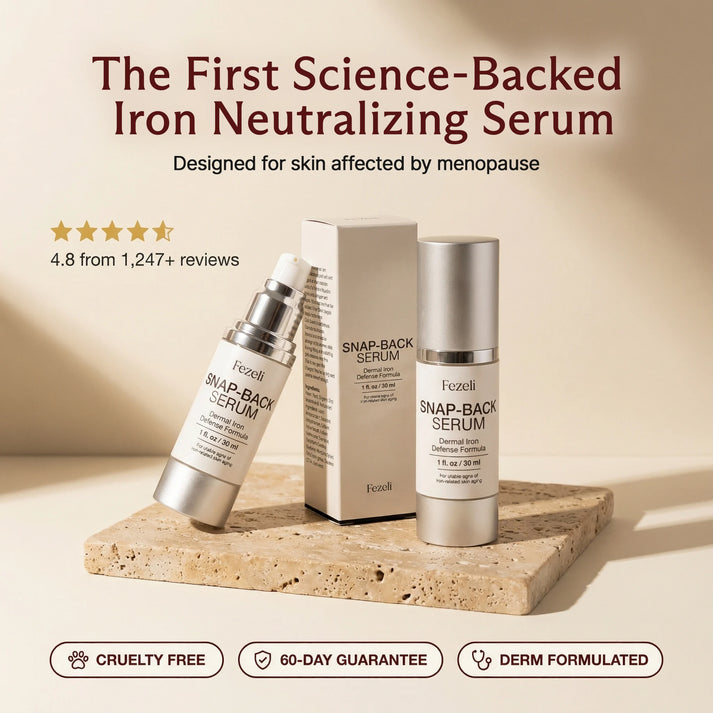
A serum built around the 2026 dermatology review that reframed what actually causes age spots after menopause. Two mechanisms. One bottle. Designed to slot into your existing routine, not replace it.
- Targets the dermal driver of post-menopausal age spots, not just the surface pigment
- Built around butylresorcinol — the active dermatologists rate higher than hydroquinone in head-to-head testing
- Visible fading of smaller spots between weeks 8 and 12 with nightly use
60-Day Money-Back Guarantee · Keep the Bottle Either Way

Built on the Published Mechanism
The formula is anchored to the 2026 Huang, Alavi, and Chen review in the International Journal of Women's Dermatology, building on the foundational 2013 Pelle paper documenting 42% more stored iron in postmenopausal skin.
Two Active Layers, Not One
Most brighteners work only at the surface. Snap-Back combines butylresorcinol (which exceeds hydroquinone in head-to-head tyrosinase inhibition — Kolbe 2013) with a dermal-layer antioxidant defense designed to neutralize the iron-driven oxidative stress underneath.
Designed for Post-Menopausal Physiology
Not a generic "anti-aging" serum. Formulated specifically for skin affected by the iron, ferritin, and antioxidant-capacity changes that follow menopause (100–200% rise in ferritin, 45% drop in total antioxidant capacity — Pelle 2013).

It wasn't the brighteners. It wasn't you.
You've used vitamin C for years. Maybe you tried hydroquinone, at the 2% over-the-counter strength or the prescription kind your dermatologist suggested. You may have cycled through arbutin, kojic acid, licorice extract. Every brightener you've ever been told to try.
The spots on your hands have not lightened. In some cases they have spread.
Those products were not broken. You were not using them wrong. They were doing exactly what they were designed to do at 40 and 45. Something changed about your skin after menopause, and they were never built for it.
Before menopause, your body cleared roughly 30 milligrams of iron every month through your cycle. After menopause, that exit closed. The iron started accumulating in your skin tissue and now sits there for 60 days at a time, while skin renews itself every 26.
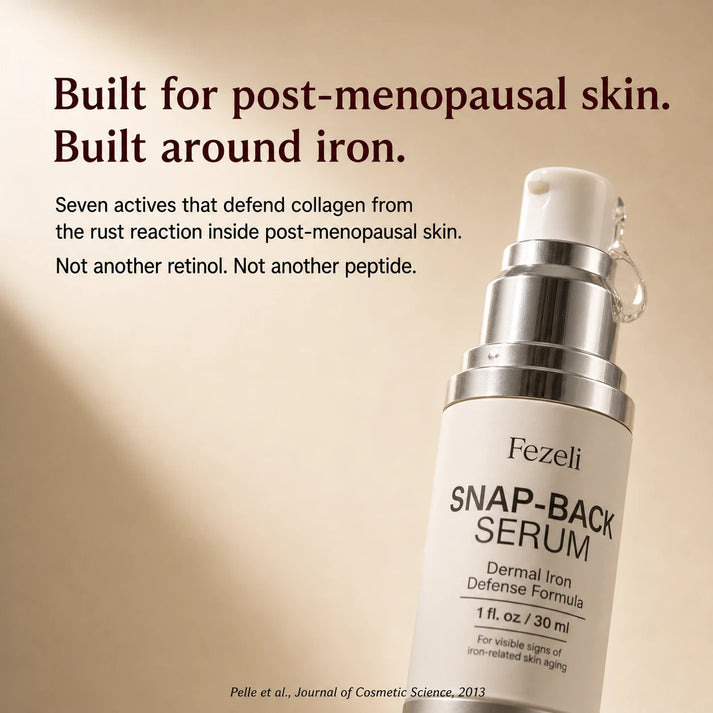
A 2013 study by Pelle and colleagues in the Journal of Cosmetic Science found that postmenopausal skin contains 42% more stored iron than premenopausal skin. The 2026 Huang, Alavi, and Chen review in the International Journal of Women's Dermatology consolidated three decades of research on what that iron does once it accumulates.
It drives the Fenton reaction. Continuous free-radical generation in the dermal layer, twenty-four hours a day, destabilizing the melanocytes that produce pigment.
Your brighteners were aimed at the surface. The driver was two layers deeper.

Why Vitamin C and Hydroquinone Can't Reach the Driver

Once you know what's driving post-menopausal age spots, the failure of every familiar brightener explains itself.
Vitamin C is a real antioxidant. At 40, it kept up with the oxidative load your skin was producing. At 60, with 42% more stored iron driving continuous free-radical generation, the math is different. The dermal oxidative load now significantly outpaces what topical vitamin C can neutralize at the surface.
Hydroquinone blocks melanin production at the surface. It cannot reach the iron in the dermal layer. So while it suppresses the spots for a few months, the driver continues underneath. The moment you stop using it (and dermatologists do not recommend long-term use because of ochronosis risk), the spots tend to return, sometimes more pronounced than before. Most women in their 60s who have used hydroquinone have lived this exact arc.
Arbutin, kojic acid, and licorice extract are gentler versions of the same surface-only approach. They face the same structural problem and produce more modest results to begin with.
The common failure is geographic. Every familiar brightener works at the surface of the skin. None of them was designed to neutralize the dermal oxidative driver that keeps the melanocytes destabilized in the first place.
Snap-Back was built around the combination the 2026 mechanism actually calls for.
Two Mechanisms. Two Layers. One Bottle.
Most brighteners do one thing. The 2026 review's mechanism requires two.

The first is a dermal-layer antioxidant defense designed to neutralize the iron-driven free radicals before they reach and destabilize your melanocytes. This is the layer almost no consumer brightening product addresses.
The second is butylresorcinol, working at the surface to inhibit the tyrosinase activity producing the visible melanin while the deeper driver is being quieted.
Both, together, in a serum formulated specifically for skin affected by menopause. Not generic "anti-aging." Not generic "brightening." Built around the chemistry the 2026 review identified.
Seven Ingredients. Two Active Layers. Built Around the Science.
Each ingredient is mapped to the layer it works in: (S) surface · (D) dermis · (B) both.

-
S
01
Butylresorcinol
The Better Brightener
Exceeds hydroquinone, arbutin, and kojic acid in head-to-head tyrosinase inhibition testing (Kolbe et al., 2013, JEADV). At 0.3% over 24 weeks, 84% of patients in a multicentric trial showed good response on melasma — the most stubborn form of post-menopausal hyperpigmentation (Khemis et al.). Non-photoreactive, safer for daytime layering than ascorbic acid.
-
D
02
Tocopherol (Vitamin E)
The Lipid-Layer Iron Defender
The antioxidant that lives inside the cell membrane where iron does its damage. Binds to iron within lipid membranes to slow the Fenton reaction at its source, protecting against the lipid peroxidation that destabilizes melanocytes (Yamaoka & Edge, 1989, Lipids; Linus Pauling Institute clinical synthesis).
-
B
03
Niacinamide (Vitamin B3)
The Tone Equalizer
12-week clinical trial: 14% improvement in skin tone clarity, 21% reduction in fine lines at 5% concentration (Bissett et al., 2004, International Journal of Cosmetic Science). Reinforces the skin barrier and reduces visible discoloration.
-
S
04
Ethyl Ascorbic Acid
The Collagen Supporter
A stable, oil-soluble vitamin C derivative. At 30% concentration, the 2021 Tedesco study in Life documented significant collagen increase in human keratinocytes and dermal fibroblasts, plus measurable reduction in melanin content in reconstructed human pigmented epidermis.
-
B
05
Sodium Hyaluronate
The Hydration Anchor
Three molecular weights for depth-balanced hydration: Low MW penetrates deep to restore turgor pressure; Medium MW binds to mid-dermis for lasting hydration; High MW creates a surface moisture barrier. Particularly relevant for postmenopausal skin, which loses hyaluronic acid alongside collagen.
-
S
06
Acetyl Hexapeptide-8 (Argireline)
The Texture Smoother
Reduces wrinkle depth up to 30% after 30 days at 10% concentration (Blanes-Mira 2002; replicated 2023 with Visia Complexion Analysis, PMC10665711). Supports surface smoothing and skin elasticity.
-
S
07
Caffeine
The Microcirculation Activator
Constricts surface vessels and supports lymphatic drainage. Documented in dermatology literature for periocular brightening and vascular tone improvement (Journal of Drugs in Dermatology, 2024, PMC11175953).
Real Hands. Real Results.
Customer-submitted photos and feedback. Names changed where requested. Always with consent.

"I'd stopped putting my hands on the table at lunch. Started keeping them in my lap. By week eight I forgot to do it. By week twelve I noticed I'd forgotten."— Linda T., 64

"The spots between my knuckles were the worst part. A friend asked, gently, if I'd tried anything for them. I had tried everything. This is the only one I noticed working."— Patricia M., 66

"I used to slide my wedding ring off and look at the lighter skin underneath. After fourteen weeks the difference is smaller. It's the thing I check most."— Diane K., 62
Real Customers. Real Hands.
Submitted by women on the routine. Before on the left, after consistent nightly use on the right.


Choose Your Protocol
Most women notice smaller spots beginning to fade between weeks 8 and 12. The 90-day supply matches the timeline used in clinical brightener trials. The 6-month protocol is for women with deeper, more stubborn pigmentation.



Our 60-Day Guarantee
Bottle Goes in Your Drawer, Not Back to UsTry Snap-Back Serum for a full 60 days. If you don't see your age spots beginning to fade, or your hand and skin texture improving, we'll refund every penny.
No forms. No hassle. No questions.
Your 60 days starts the day your serum arrives, not the day you order. That gives you real time to follow the routine and see what it does.
Just email support@fezeli.com. And whatever you decide, the bottle is yours to keep.
Frequently Asked
What is Snap-Back Serum and how is it different from other brightening products?
Snap-Back is built around a 2026 dermatology review by Huang, Alavi, and Chen that identified the dermal-layer mechanism driving post-menopausal hyperpigmentation: iron accumulation in skin tissue after the menstrual iron-exit closes at menopause. Most brighteners target only the surface symptom (melanin). Snap-Back targets both layers: butylresorcinol at the surface to inhibit tyrosinase, plus a dermal-layer antioxidant defense to neutralize the iron-driven free radicals destabilizing the melanocytes underneath. Designed to complement your existing routine, not replace it.
I've already tried vitamin C and hydroquinone. Why would this be different?
Because Snap-Back targets the layer your existing brighteners don't reach. Vitamin C and hydroquinone work at the surface. The driver of post-menopausal age spots is iron accumulation in the dermal layer, two layers deeper. The 2026 review explained the mechanism for the first time in consumer-accessible language. Snap-Back is built around the combination the mechanism actually requires: a dermal antioxidant defense plus butylresorcinol, the surface brightener that outperforms hydroquinone, arbutin, and kojic acid in head-to-head testing (Kolbe et al., 2013).
What is iron accumulation, and what does it have to do with age spots?
Before menopause, your body cleared roughly 30 milligrams of iron every month through menstruation. After menopause, that exit closed, but you're still absorbing iron from food, supplements, and water. It builds up in your skin tissue and stays there for 60 days at a time, while skin renews itself every 26. In the presence of oxygen, accumulated iron drives the Fenton reaction, which generates free radicals continuously in the dermal layer. Where those free radicals reach the melanocytes (the cells that produce pigment), the melanocytes destabilize and overproduce melanin. The visible result is age spots, especially on the most exposed body parts — hands, chest, temples, sides of the face. Pelle et al. (2013) documented 42% more stored iron in postmenopausal skin.
Is there real research behind this?
Yes. The foundational paper is Pelle et al., 2013, in the Journal of Cosmetic Science, documenting 42% more stored iron in postmenopausal skin. The 2026 narrative review consolidating three decades of research is Huang, Alavi, and Chen in the International Journal of Women's Dermatology (PMC12799301). Independent confirmation comes from the Pourzand lab review in Antioxidants (2022) and a November 2025 dermal fibroblast study (PubMed 41462637). Butylresorcinol's superiority over hydroquinone in head-to-head testing comes from Kolbe et al., 2013. Search any of these on PubMed.
How do I apply it to my hands specifically?
Same as the face. Apply 2–3 pumps to clean hands each evening. Massage into the backs of hands, knuckles, between fingers, and onto wrists until fully absorbed. Hand skin is thinner than facial skin, so use a light touch. Follow with your usual hand cream if you use one.
Will this work on age spots from sun damage, or only on post-menopausal spots?
The mechanism Snap-Back addresses is iron-driven oxidative stress in the dermal layer, which is the primary driver of post-menopausal hyperpigmentation. Sun damage and post-menopausal iron accumulation often coexist in women over 55, so for most users the visible spots have contributions from both. Butylresorcinol is also effective against sun-induced melasma (the Khemis study reported 84% good response at 24 weeks). For pure sun damage in a younger woman with no iron accumulation, results will be more modest. The serum was designed for post-menopausal physiology specifically.
How long until I see results on my hands?
Most women notice smaller spots beginning to fade between weeks 8 and 12 of nightly use. Stubborn or darker spots take longer (12–16 weeks). Texture and tone evenness typically improve faster than individual spot intensity. The 60-day guarantee gives you the minimum window to see what it does; the 90-day supply gives you the timeline most clinical trials use.
What are the ingredients?
Water (Aqua), Glycerin, Butylresorcinol, Tocopherol, Niacinamide, Propanediol, Ethyl Ascorbic Acid, Acetyl Hexapeptide-8, Caffeine, Sodium Hyaluronate, Bakuchiol, Alpha-Arbutin, Panthenol, Bisabolol, Squalane, Pentylene Glycol, Ethylhexylglycerin, Disodium EDTA, Citric Acid. Paraben-free. Fragrance-free. Dermatologist tested.
Can I use this with my other skincare products?
Yes. Snap-Back is designed to complement your existing routine. Apply after cleansing and before your moisturizer. Works well alongside retinoids (use Snap-Back at night, retinol on alternate nights to start), most serums, and most creams. Avoid layering it at the same time as high-concentration acid products (glycolic, salicylic) to prevent irritation. Compatible with HRT-supported skincare regimens.
Is this safe? Any side effects?
The serum is paraben-free, fragrance-free, and dermatologist tested. Butylresorcinol has zero adverse events in the 2010 Huh split-face trial. All ingredients are well-established. As with any new skincare product, patch test on your inner forearm the first time you use it.
I have low ferritin or anemia. Is this safe for me?
Snap-Back works topically. It only addresses iron already deposited in your skin tissue. It does not lower your blood iron, your systemic iron levels, or your ferritin labs. There is no trade-off with hair, energy, or overall health. If you have concerns, check with your doctor.
What if it doesn't work for me?
Our 60-day money-back guarantee means you have two months to try it. If you don't see your age spots beginning to fade or your skin texture improving, contact support@fezeli.com. Full refund. Keep the bottle.
Still have questions? We're here.
Email support@fezeli.com — typical response time under 24 hours.
Or call us: +1 (855) 500-0851 — 9am to 6pm Eastern, Monday through Friday.
The Science Behind Snap-Back
Four independent academic sources, none of them tied to Fezeli.
Journal of Cosmetic Science
First to document 42% more stored iron in postmenopausal skin tissue.
International Journal of Women's Dermatology
The narrative review consolidating three decades of iron-skin research.
Antioxidants
Independent confirmation of the iron-aging connection and antioxidant defense as a therapeutic direction.
JEADV
Butylresorcinol exceeds hydroquinone, arbutin, and kojic acid in head-to-head tyrosinase inhibition.
60-day money-back guarantee. Use the entire bottle. If you don't see results, email support@fezeli.com. Full refund. Keep the bottle.